
Tianchi Lake, Xinjiang's Hidden Gem That Combines Snow-Capped Mountains and the Legend of the Heavenly Queen.

Imagine a journey where the scenery before your eyes shifts dramatically within a single region: endless sprawling deserts, lush green grasslands, mountain forests, glass-clear lakes, right up to snow-capped mountain peaks.
This is no fantasy film setting. Every one of these landscapes can be found in Xinjiang, the vast western region of China that spans approximately 1.66 million square kilometres.
Xinjiang is the largest administrative region in China, accounting for nearly one sixth of the country's total land area. Beneath its extreme geographic characteristics, this area holds one of the most remarkable natural landscapes along the Tianshan Mountains.
READ ALSO
Mark the date! Mount Bromo will be temporarily closed starting 30 May 2026.
Dream Forest Langkawi: The Thrilling Experience of Night Trekking in the Rainforest That Will Leave You Amazed
AirCab Ready for Takeoff, China's Tourism Sector Enters a New Premium Travel Era
One of the crown jewels here is Tianshan Tianchi Lake, more commonly known simply as Tianchi -- a name that translates to "Heavenly Lake".
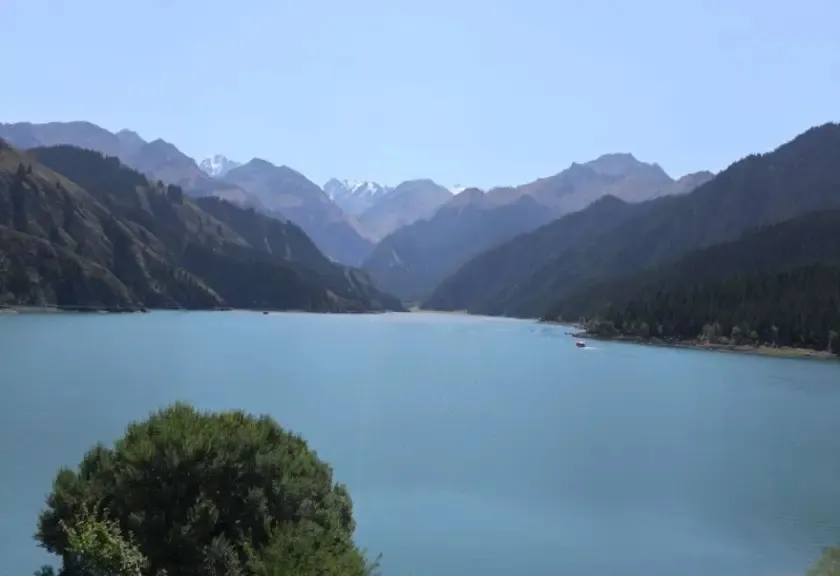
Nestled within the Tianshan mountain range, Tianchi offers an experience unlike most other lake destinations. At its heart lies the lake's distinctive blue-green water, framed by spruce forests, mountain ridges and open sky to create an overwhelmingly vast panorama.
But there is far more to this area than just natural beauty. Tianchi also immerses visitors in ancient Chinese mythology, while demonstrating how a natural tourist destination can balance visitor volumes with critical conservation needs.
Tianchi and Xinjiang's Striking Geographic Contrasts
One of Xinjiang's most defining features is its dramatic geographic contrast.
The region is ringed by major mountain ranges and large basins: the Altai Mountains and Junggar Basin lie to the north, while the Kunlun Mountains and Tarim Basin stretch across the south.
Between these formations sit the Gurbantünggüt Desert and Taklamakan Desert -- two vast arid regions that give Xinjiang its signature extreme character.
Running west to east through the centre of Xinjiang is the Tianshan Mountains. It is here that the landscape shifts abruptly, transitioning from arid desert terrain into lush, green mountain habitat.
UNESCO inscribed the Xinjiang Tianshan as a World Heritage Site in 2013, recognising the area for its unique combination of snow peaks, glaciers, forests, grasslands, rivers and lakes sitting adjacent to the great Central Asian desert landscapes.
In other words, the journey to Tianchi is about far more than reaching a single lake. This trip reveals how changes in elevation and climate can create wildly different landscapes within one continuous region.
The Heavenly Lake of the Tianshan Mountains
Tianshan Tianchi Lake sits in the Bogda Mountain Valley, part of the greater Tianshan range. Administratively it falls within Fukang City, approximately 110 kilometres from Urumqi, the capital of Xinjiang.
Upon entering the reserve area, visitors are greeted by a panorama of the lake's blue-green waters, backed by rolling mountain slopes covered in dense spruce and pine forest.
Tianchi's water colour shifts from pale jade green to deep turquoise depending on light conditions and the time of year.
This crescent-shaped lake covers an area of around 4.9 square kilometres. It sits at an elevation between 1910 and 1980 metres above sea level, with a maximum recorded depth of 105 metres.
For visitors, one of the simplest and most rewarding ways to experience Tianchi is to walk slowly along the lake shore. There is no need to rush between photo spots -- even small changes in viewing angle reveal entirely new perspectives of the landscape.
Visitors may also tour the lake aboard electric passenger boats operated by the reserve management.
"Swimming and fishing are strictly prohibited here. Guests may only enjoy the lake from the shorelines, or aboard the approved electric tour vessels," explained He Xianglan, Head of the Ecology and Environment Division of the Tianshan Tianchi Lake Management Committee, during an interview with ANTARA at the lake site on Saturday 29 August.
Visitor numbers continue to grow each year. He reported that approximately 3.4 million people visited the reserve in 2025, marking a 10 percent increase over the previous year.
Notably, Tianchi does not have a single peak tourist season.
"There is no defined peak season here. We receive visitors every month of the year. Tianchi Lake presents a completely different kind of beauty in every season," He stated.
Tianchi Transforms With Each Changing Season
Seasonal change is an integral part of the Tianchi visitor experience.
When winter arrives, the lake surface typically begins freezing over around December, before thawing again each April. This annual freeze-thaw cycle marks the transition between the reserve's winter and warmer season tourism offerings.
For winter sports enthusiasts, the area is home to the Tianshan Tianchi International Ski Resort, which operates seven ski runs suitable for all ability levels from first-time beginners to advanced skiers.
Tianchi changes entirely once summer arrives.
The surrounding natural forest becomes one of the reserve's main attractions. Covering approximately 114,660 hectares, this forest supports an extremely diverse range of plant life.
The forest is dominated by Tianshan Schrenk spruce trees. Beneath their canopy grow a wide variety of shrubs including wild rose, honeysuckle and hawthorn.
In open meadow areas visitors will find forget-me-nots, golden root plants, and the famous Tianshan snow lotus -- one of the region's most iconic endemic species.
This ecosystem also supports a wide range of wildlife. Most famously it is home to the snow leopard, while Tianshan red deer can often be seen grazing in forest clearings and grasslands.
The presence of habitat for so many rare and endemic species is one of the core reasons for the Tianshan region's enormous ecological value. UNESCO notes that Xinjiang Tianshan supports exceptionally high floral and faunal diversity, including many endangered and threatened species.
Feilong: The Small Lake With Dragon Legends
Exploring the areas surrounding Tianchi reveals many more equally remarkable landscapes.
Walking east from the main lake brings visitors to Feilong Lake, also known as the Flying Dragon Pool. This small lake covers around 10,000 square metres and sits at an elevation of 1875 metres.
It is fed entirely by overflow water from Tianchi Lake, which runs through a natural channel on the northeast shore of the main lake.
Feilong's appeal extends beyond its natural scenery. Waterfalls at the lake's inlet and outlet create flowing white cascades that from a distance look like a white dragon descending from the mountains.
This is the origin of the name Bailong Valley, or White Dragon Valley.
Feilong Lake also carries its own local legends. Local folklore holds that this spot was once the bathing place of the Queen Mother of the West, and also served as a lair for a black dragon.
With the same blue-green water, surrounding Schrenk spruce forest and wild flowers, Feilong Lake feels like a landscape pulled straight out of ancient myth.
Where Nature Meets Chinese Mythology
Tianchi Lake has deep, ancient ties to Chinese folk tradition.
In Chinese mythology this lake is identified as Yaochi, the Jade Pool -- the summer palace garden of Xi Wangmu, the Queen Mother of the West.
Xi Wangmu is one of the most prominent figures in classical Chinese mythology, most famously associated with immortality and the secrets of eternal life.
One of the best known legends tells the story of King Mu of the Zhou Dynasty, who travelled far west to the Kunlun Mountains where he met the Queen Mother.
According to the tale, Xi Wangmu invited King Mu to her summer palace at Tianchi.
Their meeting concluded with a promise.
As King Mu prepared to depart for his kingdom, the Queen asked if he would ever return. The King replied: "Once I have returned to Zhongyuan, led my people to peace and prosperity, I will come back to you."
That promise was never fulfilled.
King Mu never returned. Tianchi Lake remains as the quiet witness to this ancient tale. Today, a temple dedicated to Xi Wangmu stands on the eastern shore of the lake, marking the legend for modern visitors.
For travellers, this layered history means Tianchi is far more than just a natural attraction. The landscape visitors stand before today is connected to stories that have been passed down for thousands of years.
"This is the reason we do not run mountain bike events, trail races, or promotional festivals for Tianchi Lake. The story of this lake is already known across all of China. People travel here from every region because they grew up hearing these folk tales, and want to see this place for themselves," He explained.
Managing Millions Of Visitors While Protecting Nature
The popularity of any natural destination brings with it unique challenges.
As visitor numbers rise, so too does the responsibility to ensure the natural environment is not sacrificed for tourism.
The Tianchi Lake reserve management reports that over 1 billion RMB (approximately 2.1 trillion Indonesian Rupiah) has been invested in environmental protection programmes since 2016.
These funds have been allocated to ecological restoration, wetland protection, reforestation and other conservation initiatives.
Livestock grazing has also been fully prohibited across an area spanning nearly 330 square kilometres within the reserve.
According to management data, these efforts have successfully restored almost 100,000 hectares of land. Carbon storage has increased by 328,800 cubic metres, while grassland vegetation cover has risen from 34 percent in 2012 to approximately 90 percent today.
Green tourism principles are integrated into all operations of the reserve.
All vehicles used inside the tourist area -- including shuttle buses and tour boats -- run entirely on electric power. On-site catering facilities and heating systems also operate using renewable energy sources.
"All tour boats have been converted to electric motors. There is no longer any diesel fuel odour on the lake surface at all," He added.
Alongside phasing out fossil fuels, the reserve has installed a network of environmental monitoring stations.
These stations track a full range of parameters including air quality, temperature, humidity, wind speed and direction, as well as negative oxygen ion levels.
"We have placed these monitoring stations at locations across the forest and lake areas, allowing us to collect real time, regular environmental data," He stated.
For visitors, this approach adds another important layer to the experience of Tianchi. True beauty is not just what you see before your eyes -- it is also the work done to preserve that landscape so that it may be enjoyed for generations to come.
Practical Visitor Guide For Tianchi Lake
Tianchi Lake is easily accessible from Urumqi. The road journey from the Xinjiang capital to the reserve entrance takes approximately 1.5 hours by private car or public bus.
Between April and October, entry tickets are priced at 95 RMB (approximately 210,000 IDR) per person. For visits between November and March, the entry ticket price is reduced to 45 RMB (approximately 100,000 IDR).
The journey does not end at the reserve entrance however.
All visitors are required to take the official electric shuttle bus up to the lake area. This shuttle costs 60 RMB (approximately 133,000 IDR) per person, with the journey uphill taking around 40 minutes.
Visitors can choose the best time to travel based on what experience they are looking for.
Winter visits offer snow covered landscapes and access to the ski resort, while summer is ideal for exploring the forest, viewing wild flowers, taking lake boat tours and enjoying the open lake panorama.
Tianchi is also an exceptional destination for landscape photography. The combination of water, forest, mountain peaks and changing light throughout the day means a single viewpoint can yield completely different images.
Ultimately, what makes Tianchi so special is that it offers something for every kind of traveller.
There is the grand Tianshan mountain landscape for nature lovers, forest and wildlife for explorers, the Xi Wangmu legend for those interested in history and culture, and the reserve's sustainable tourism model for anyone curious about how natural destinations can be managed responsibly.
Set amidst the vast expanse of Xinjiang, stretching between desert and high mountains, Tianchi Lake stands as a high altitude oasis.
It is not just an oasis for its striking blue-green waters. This is the place where nature, mythology, culture and conservation come together, all on one journey.









Belum ada komentar. Jadilah yang pertama!