
Getting to Know Sade Traditional Village, the Sasak cultural heritage that has now been struck by fire.

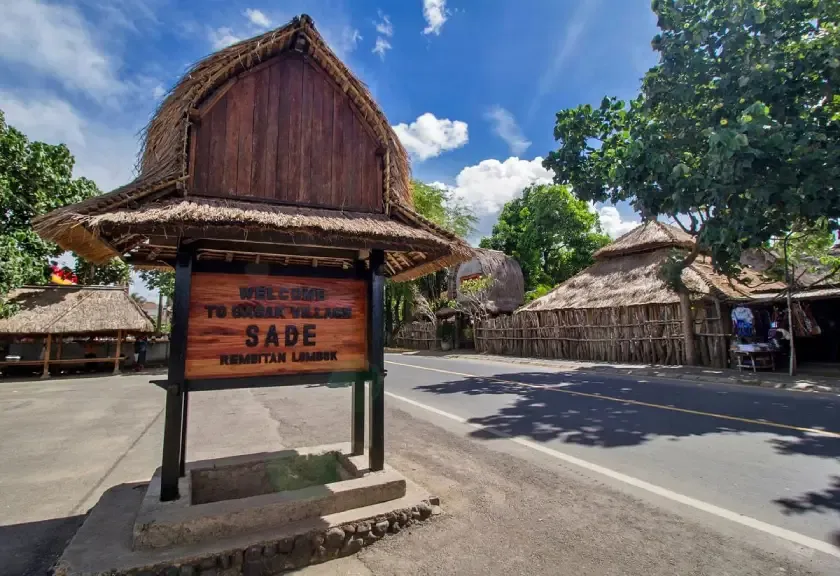
The Sade Traditional Village has returned to public attention following a massive fire that swept through the Sasak ethnic community settlement in Rembitan Village, Pujut District, Central Lombok Regency, West Nusa Tenggara, on the evening of Saturday, 22 August 2026.
This fire did not merely destroy residential buildings. Sade has long been recognised as one of Lombok's flagship cultural tourism destinations, a site where visitors can observe first-hand the daily life of the Sasak people, traditional architecture, and the many living customs preserved by the community.
Initial reports indicated approximately 120 traditional homes had burned down. Following full on-site data collection however, updated figures confirm 129 households were completely destroyed. The blaze displaced around 320 residents, with no fatalities recorded in the incident.
READ ALSO
6 Indonesian Destinations Beyond Bali Praised by Global Travel Media
Culinary & Cultural Tourism Blend at Surabaya's Rujak Uleg Festival 2026
2026 Cap Go Meh Festival: Strategy to Strengthen Singkawang as a Leading Cultural Tourism Destination
Witnesses reported the fire broke out late on Saturday night and spread rapidly between structures. Most buildings in the village are constructed from timber, bamboo and thatched grass, which allowed the fire to jump quickly from one home to the next. Dozens of fire truck units were deployed from across West Nusa Tenggara to assist with extinguishing efforts.
Amidst this tragic news, it is important to revisit what makes Sade Traditional Village unique, and why this settlement holds such profound significance for Lombok's cultural heritage and tourism industry.
Sade: The Sasak Village Guarding Ancestral Heritage
Located within Rembitan Village, Pujut, Central Lombok, Sade is one of the last remaining Sasak communities that still fully upholds traditional settlement patterns, social life and architectural practices.
For decades, Sade has grown into one of the most visited cultural tourism destinations in the region. According to Indonesia Travel, the community has maintained their unbroken customary practices across approximately 15 generations. All residents of the village remain connected through close kinship ties within the local community.
Sade is not an open-air museum of static old buildings for tourist viewing. Every traditional home in this village is an active, lived-in part of daily community life.
This is precisely Sade's core appeal. Visitors do not travel here only to photograph traditional house designs. They come to witness how the Sasak people conduct their daily lives, uphold their customs, and pass down craft skills inherited from previous generations.
Before the fire, Sade was home to roughly 150 traditional houses and supported a resident population of between 700 and 750 people. These figures reflect that Sade is first and foremost a living community, not just a tourist attraction.
The Philosophy Behind Sade's Traditional Architecture
One of Sade's most defining characteristics is its distinctive traditional housing design.
Sasak homes are built entirely using materials sourced from the surrounding local environment. Roofs are thatched with dried grass or rice straw, walls are constructed from woven bamboo, while traditional house floors are made from a compacted mixture of clay, buffalo dung and rice husk ash.
These materials are not chosen arbitrarily. The floor compound cures to a hard, durable surface that regulates internal conditions inside the home. This construction technique is part of the indigenous knowledge passed down orally through each generation.
The buildings also have very distinct design traits. The steep, mountain-profile roof shape is the most immediately recognisable feature of Sasak traditional homes in Sade.
Houses are also built with deliberately low, narrow entrance doors. This architectural choice reflects how the Sasak people designed their homes both to adapt to local environmental conditions, and to embed core traditional cultural values into their built environment.
At the same time, the use of natural organic materials like wood, bamboo and thatch makes these traditional homes highly vulnerable to fire. During Saturday night's blaze, these same materials allowed the fire to spread at devastating speed across the settlement.
Beyond Buildings: The Living Traditions Of Sade
Sade's cultural value extends far beyond its architecture. This village is also one of the best places to experience authentic Sasak culture firsthand, most notably through the living tradition of hand weaving.
Weaving is a central part of life for women in Sade. This skill is taught from early childhood, and remains one of the community's core ways of preserving their cultural heritage. Visiting tourists can observe the full handweaving process directly, and purchase finished textiles made by local residents.
Many other social and customary traditions are also still strictly observed in Sade, including the distinct formal ritual procedures for Sasak traditional marriages.
As noted by Indonesia Travel, social life in Sade is also deeply integrated with Islamic practice. All community and religious affairs are conducted in shared communal spaces including the village mosque and the Baruga Sekenam meeting hall.
For this reason, visiting Sade is never just about taking photographs in front of thatched-roof houses. More than anything, it is an opportunity to witness how an indigenous community sustains its collective identity amid the pressures of growing tourism and modernisation.
When A Cultural Tourism Icon Burns
The Saturday night fire has delivered a devastating blow to the Sade community.
The fire was first reported at approximately 10:00 PM WITA (Central Indonesian Time). Residents and emergency personnel worked simultaneously to fight the blaze and evacuate civilians from the settlement. The exact cause of the fire remains under investigation and has not yet been officially confirmed.
Updated disaster response figures confirm 129 homes were completely destroyed. Hundreds of residents were evacuated, with most taking shelter at emergency relief sites or staying with extended family members.
The Government of West Nusa Tenggara Province has announced it will proceed with full reconstruction of the burned traditional village. West Nusa Tenggara Governor Lalu Muhamad Iqbal stated that Sade must be rebuilt urgently, as it stands as a primary cultural icon of the Sasak people.
Yet rebuilding Sade will never be as simple as constructing new physical structures.
What must be restored is not only the shape of the buildings, but the community's daily life, cultural spaces, traditions, craft practices, and the collective identity that made Sade such a vital part of Lombok's tourism landscape.
This fire may have temporarily altered the physical face of Sade. But the living cultural heritage carried within the community should never be lost alongside the burned buildings.
Sade reminds us that a cultural tourism destination is never defined by its structures alone. At its core it is made of people, history, tradition, indigenous knowledge, and ways of life passed down across hundreds of years.
That is why as reconstruction work begins, the greatest challenge will not be recreating what the eye can see. It will be ensuring that the living Sasak cultural spirit which has always been Sade's true strength, remains alive for generations to come.









Belum ada komentar. Jadilah yang pertama!